Going Digital to Grow, Going Analog to Believe
Introduction
We designed the theme of the present survey, “Going Digital to Grow, Going Analog to Believe,” as follows.
- The rapid digitalization since the COVID-19 pandemic is now accompanied by a trend of returning to analog.
- HILL’s Chronological Lifestyle Survey found that the use of videoconferencing services has remained high since their explosive growth in 2020, and yet attending New Year’s parties has rebounded since 2024, pointing to a mix of digital and analog.
- In this seminar, we explore the new values that sei-katsu-sha are finding in both digital and analog, rather than choosing one or the other.

Part 1
Dual sides of digitalization
We outlined the current status of digitalization in life and the ambivalence that is emerging among sei-katsu-sha.
The reality of digitalization as identified by the Chronological Lifestyle Survey on DX
Based on a large-scale survey with 5,000 samples nationwide, we analyzed how people are switching between digital and analog in 30 areas of behavior.
-
Areas with a high digital percentage:
- Consulting cooking recipes (digital: 65.8%)
- Searching for products (digital: 60.0%)
- Paying small amounts of money in store (electronic payment: 52.0%)
-
Areas with a high analog percentage:
- Searching for someone to love (online: 25.3%)
- Trying on clothes or makeup (virtual: 16.7%)
- Seeing a doctor (online: 9.7%)

Benefits of digitalization, but ambivalence inside
Sei-katsu-sha are facing new challenges while benefiting from digitalization.
-
Outside (benefits):
Many recognize greater convenience (74.3%) and improved efficiency (67.9%). Over 30% also feel they are more sensitive to information and have improved time management.
-
Inside (ambivalence):
-
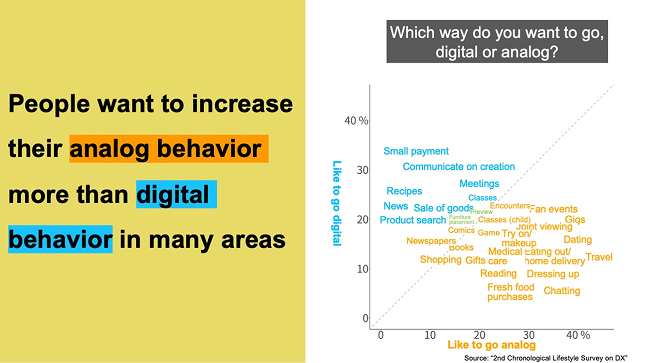
Wishing to increase their analog behavior more than their digital behavior: In 20 of the 30 areas, more people want to increase their analog behavior than their digital behavior.
These results indicate that sei-katsu-sha are not fully proactive about going digital.
- They increasingly feel overwhelmed by information (32.2%), more stressed (25.5%) and more easily tired (27.6%).
- Reviews and recommendation functions are leading them to increasingly purchase well-known, popular products or repeatedly buy the same products. They have started to realize that their behavior is stagnating and that they should be enjoying more options.
-
Wishing to increase their analog behavior more than their digital behavior: In 20 of the 30 areas, more people want to increase their analog behavior than their digital behavior.

Part 2
Going digital to grow, going analog to believe
Amid this ambivalence toward digitalization, how are sei-katsu-sha managing to be “versatile,” finding new values in both digital and analog? We tried to answer this question by analyzing the real voices of sei-katsu-sha.
Going digital to develop one’s own sensitivity
A trend of developing one’s own sensitivity through the inefficient use of tools that are supposed to deliver efficiency and correct answers.

-
Freedom from recommended for you → Want to struggle to find the right answer:
Seeing her sister efficiently search for a job online, a high school student could not help but feel a sense of waste. So she contacted and met up with a creator whom she happened to find on TikTok. Witnessing a completely different way of life effectively broadened her mind and led her to search for her own unique career.
-
Freedom from timelines → Want to dig deeper:
A male in his 40s continues to listen to his favorite radio program that he digitally recorded 10 years ago. Unlike the timeline that feeds information at high speed, listening to the same program over and over again allows the information to “ripen” inside him, such as when finding new implications in the discussion, thus developing his unique interpretations unaffected by the impressions of others.
-
Freedom from cost/time-performance → Want to appreciate wasted time:
A couple in their 20s enjoy walking untraveled roads to fill in “gaps” on the map, with the help of the “footprint” function of a location data sharing app. “Efficiency does not leave us with memories. It is inefficiency that brings us intriguing discoveries like finding a new shop.” They are intentionally creating “waste-of-time” moments.

Going analog to believe in one’s own energy
A trend of leveraging analog to make sure of their aspirations or bonds, which cannot be stored as data.

-
Freedom from no degradation → Want to register my aspirations:
A high school student makes it a rule to choose new printed study books for learning, so that the wear and tear reflects his effort and gives him a sense of accomplishment. For him, a worn-out study book is not simply a used item but has special value as evidence of his effort.
-
Freedom from foes → Want to be with real friends:
A high school student was pleased to see a huge number of fans the first time he went to a live viewing session of an artist he had been supporting online. “I am proud to be one of those fans.” He felt reassured and encouraged, finding himself in a place filled only with friends—something that cannot be gained from the social media follower number.
-
Freedom from one click → Want to make encounters my destiny:
In an era when you can easily buy any stuffed animal on an e-commerce site, someone travels to a shop to “unearth” the one that belongs to her from among the hundreds of stuffed animals on display. “I found this little one, who was calling for me.” She is developing emotional ties with things through a special process of encountering that cannot be imitated by efficient one-click buying.

Going digital to grow while going digital to believe
A sei-katsu-sha searching for his favorite landscape on Google Street View and sketching it with analog pens is a case in point. From among the random digital images not representing anyone’s intention, he sniffs out a landscape on his own to be hand-drawn. He shares his works with friends on social media before actually visiting that place. Drawing a sketch beforehand makes him “discover” a shop that he hesitated to draw or gives him a feeling of finally finding a place he already loves, effectively changing a trip into a much deeper experience. This cycle gives him a destination of his own, rather than everyone else’s destination that you can find in a guidebook.


Part 3
Implications for business activities
We considered how companies should address those “versatile sei-katsu-sha” presented in Part 2.
-
Media perspective:
- Based on their understanding of algorithms, sei-katsu-sha are trying to create encounters by “hacking” the algorithm by, for instance, “liking” a video that has not been recommended.
- Some of them are “growing” AI by instructing it to learn their diaries and, based on this understanding, to propose something unknown to them.
-
Purchasing perspective:
- RomCommerce lures customers from entry points that are not intended to induce purchase. Customers encounter products in natural ways while enjoy content such as TV dramas, eventually purchasing them.
- Store visits can be triggered by creating an encounter that sei-katsu-sha might feel is like destiny, such as a one-of-a-kind product upcycled from secondhand clothes.

Wrap-up
To conclude, we propose the following regarding the relationship between technology and humans, building on the results of our research.
- Technology has a dual nature, augmenting the abilities of humans while making them dependent on it.
- Going forward, sei-katsu-sha will become increasingly “versatile,” mastering digital and analog skills to find entertainment value not only from improved efficiency but also from making detours and exploring, rather than simply letting technology take the lead. It is a shift from choosing between digital and analog to making the best of both.

