Japanese Youth: 30 Years of Change
Our thematic research seeks to elucidate the realities of society today by observing trends based on the results of long-term historical surveys. Thus far, we have followed trends among the elderly, children and families for spans of 20 or 30 years. This year’s theme is “Japanese Youth: 30 Years of Change.”
Introduction
We considered the following perspectives in conducting this thematic research:
- Youth is one of the hottest themes throughout the ages, and tends to be regarded as a hard-to-understand subject.
- Many people probably feel uncomfortable with narratives about youth, thinking: “Young people have always been like this.” “That can be said of any cohort, and doesn’t just apply to young people nowadays.”
- In this session, we seek to trigger reflection based on that sense of discomfort.

Part 1
True or false? Conventional wisdom about youth
We sought to verify the relevance of conventional wisdom about youth with long-term time-series data.
-
Target of the present long-term time-series survey
- Single males and females aged 19–22
- Target of youth survey 30 years ago, in 1994, now aged 49–52
Triggering and proposing the future
- “Constant” image of youth (universal characteristics of young people that have not changed over the years)
-
“Non-unique” image of youth (characteristics of people in general today including older generations)
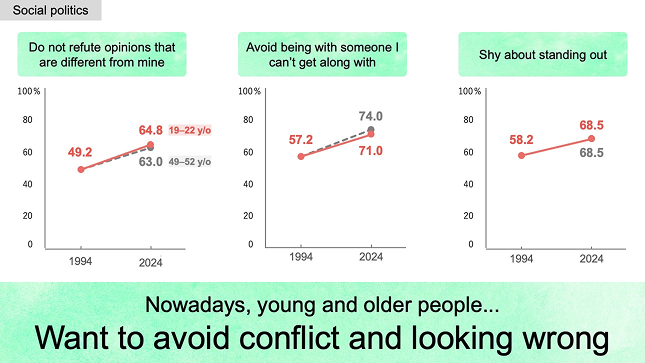
-
“Incorrect” image of youth (characteristics wrongly attributed to young people by prevailing narratives)
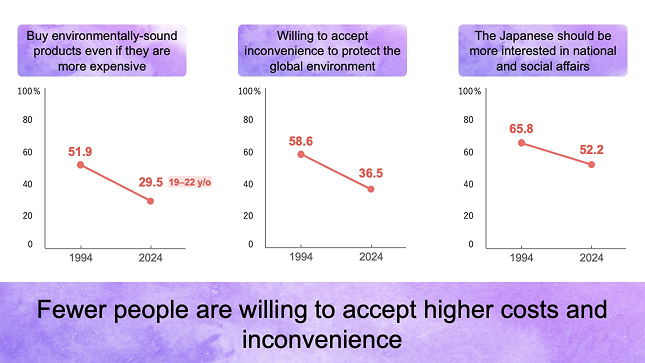
Part 2
Gen Z driven by mothers and same-gender peers
The biggest change among youth over the 30 years lies in their personal relationships. We analyzed this change with long-term time-series data and the results of qualitative surveys.
- Mothers and same-gender peers have become extremely important for young people.
-
For Gen-Z people, their mother is a “mentor mom,” who accompanies or leads them.
- Factor 1:
Mothers are increasingly “capable,” with ample experience of studying and working. - Factor 2:
Both daughters and sons have more occasions to do things with their mother.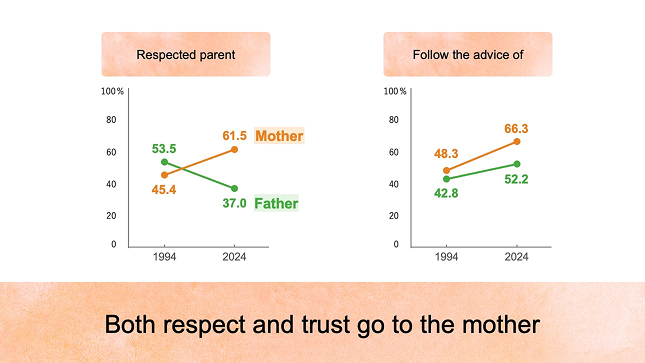
- Factor 1:
-
For Gen Z, same-gender peers are “low-risk friends” who are easy to be with.
- Factor 1:
As they limit the number of their friends, same-gender peers are “sustainable friends,” with whom they can maintain personal relationships without stress. - Factor 2:
Same-gender peers are “fellow soldiers in the information war,” with similar needs for information under similar circumstances. -
Factor 3:
Same-gender peers are an “area free from compliance,” where they do not have to be ashamed of being themselves, and can act without concern about potential harassment.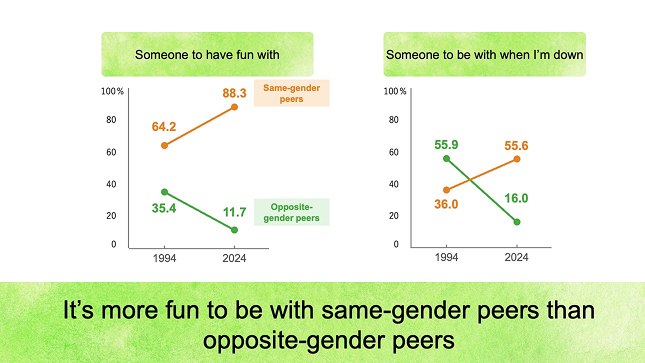
- Factor 1:
Part 3
How companies might develop relationships with Gen Z
We considered how best to adapt marketing to the changes in personal relationships among young people discussed in Part 2.
- As consumers, the values and desires behind their consumption behavior have not changed much. New desires cannot emerge easily as young people are already surrounded by a multitude of things.
- Mothers and same-gender peers could serve as triggers for consumption among youth.
- In an age where people cannot be confident about their choices, companies need to ensure “psychological safety” for sei-katsu-sha.

Wrap-up
To conclude, we summarized the characteristics of youth today as follows.

